
Understanding the College Admissions Timeline as a Parent
What happens when—and how to support your student without adding pressure.
Why the College Admissions Timeline Feels So Confusing
For many parents, the college admissions process feels like it appears all at once—deadlines, essays, testing, decisions—without a clear roadmap.
In reality, the process unfolds over several years, and understanding that timeline can make a meaningful difference in how you support your student.
At Kingfisher Prep, we find that when parents understand when things happen, they’re better able to provide support that is timely, calm, and helpful—not overwhelming.
9th–10th Grade: Building Foundations (Quietly)
These early years are not about applications—they’re about exploration and consistency.
Students should be:
Adjusting to high school academics
Exploring extracurricular interests
Developing study habits
Beginning to understand what they enjoy
Parent role: Encourage exploration without pressure. This is a time for curiosity, not strategy.
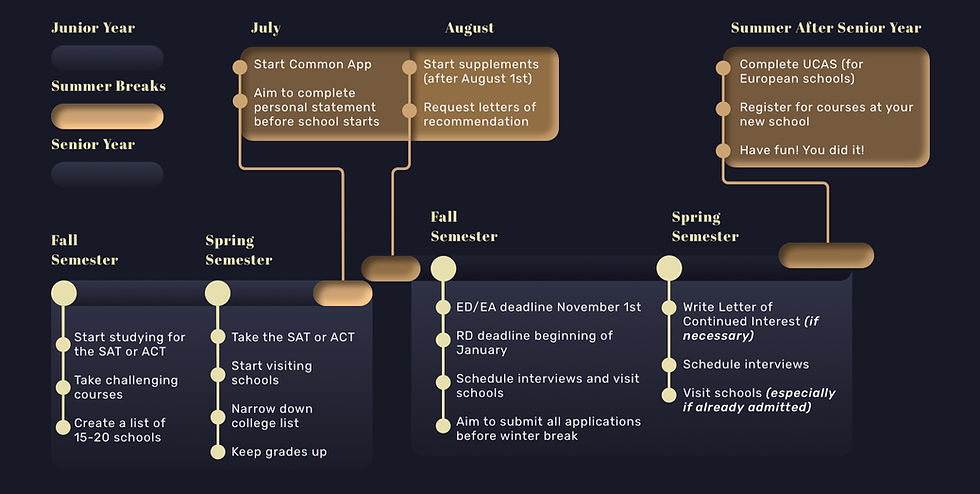
11th Grade (Junior Year): The Preparation Year
Junior year is when the process becomes more structured.
Fall & Winter
Students focus on:
Strong academic performance
Continued extracurricular involvement
Initial exposure to SAT/ACT testing
Spring
This is one of the most important (and often underestimated) phases.
Students begin to:
Build a preliminary college list
Visit colleges or attend virtual events
Take or plan standardized tests
Reflect on potential essay topics
Parent role: Help with structure and planning—but avoid taking over. This is a time to guide, not manage.
Summer Before Senior Year: The Foundation Phase
This is the most valuable window for reducing stress later.
Students should aim to:
Draft (or complete) their personal statement
Refine their college list
Begin thinking about supplemental essays
Organize activities and materials
Parent role: Support consistency and accountability—but also protect downtime. Balance matters.
12th Grade (Senior Year): Application Season
Fall (August–November)
This is the busiest stretch.
Students are:
Completing applications
Submitting Early Decision/Early Action applications
Requesting transcripts and recommendations
Parent role: Provide logistical support and emotional stability. Avoid last-minute pressure.
Winter (December–February)
Regular Decision applications are submitted
Financial aid forms are completed
Students begin to wait
Parent role: Shift from urgency to reassurance. This is often an anxious period.
Spring (March–May): Decision Season
Admissions decisions are released
Students compare options
Final decisions are made (typically by May 1)
Parent role: Help your student think through options—but let the final decision be theirs.
The Most Common Timeline Mistake
Many families assume the process begins in senior year.
In reality, the students who feel the least stress:
Start reflecting earlier
Spread out the work
Use junior spring and summer effectively
The timeline isn’t about doing more—it’s about doing things at the right time.
How Parents Can Support Without Overstepping
At every stage, the goal is the same:
Provide structure
Offer perspective
Encourage independence
A helpful rule of thumb:
Be involved in the process—but not in control of it.
Conclusion: Clarity Creates Calm
The college admissions process is complex—but it’s also predictable when you understand the timeline.
When parents know what’s coming (and when), they can support their students in a way that builds confidence rather than stress.
And that makes the entire process more manageable—for everyone.


Comments