
What This College Admissions Year Taught Us: Congratulations to Kingfisher Prep’s 2025–2026 Students
- May 21
- 9 min read
Every year, this is one of our favorite posts to write.
First and most importantly: congratulations to our students.
The college application process asks a lot of teenagers. They have to reflect on who they are, make major decisions about their futures, manage a mountain of deadlines, and sit with a level of uncertainty that can feel pretty intense for a seventeen-year-old.
And congratulations to their parents! For some this was the first time; for others it was the third or fourth. Thank you for navigating these months with us and for trusting our process.
We are thrilled to congratulate Kingfisher Prep students who have committed to the following colleges and universities for the 2025–2026 admissions cycle:
Harvard University
Columbia University
University of Pennsylvania
Cornell University
University of Michigan
New York University
Indiana University — Kelley School of Business
University of Florida
University of Wisconsin–Madison
Tulane University
University of Colorado Boulder
Syracuse University
Ohio State University
Binghamton University
Western University — Ivey Business School
Emerson College
Colgate University
Loyola Marymount University
Wesleyan University
Purdue University
University of Miami
This list reflects where our students have chosen to enroll. Across the group, our students were accepted to well over 100 colleges. About half of our students who applied to an Early Admission program decided to enroll early, while the rest waited for all of their acceptances before making a decision.
And as always, this admissions cycle taught us a lot.

This Year Was Competitive, Unpredictable, and Sometimes Frustrating
College admissions are never predictable, but this year had some especially frustrating moments.
The University of Michigan new Early Decision process, for example, was a real source of stress for many families. Decisions were delayed or pushed back in ways that left students feeling stuck in limbo. Whatever the reason, that uncertainty affected how some students felt about the school by the end of the process. For a few, Michigan moved down the list after months of frustration.
We also saw continued competitiveness at major public flagships. University of Wisconsin–Madison, in particular, was especially competitive this year. This is a useful reminder that well-known public universities should not automatically be treated as “easy” admits.
Depending on residency, major, timing, test scores, and the student’s overall profile, schools like Michigan, Wisconsin, Florida, Purdue, and others require real strategy. A popular public university may be a wonderful option, but it is not always a safety school.
Strong Test Scores Made a Difference— Especially for Merit Aid
One of the clearest patterns we saw this year was that students who submitted strong SAT or ACT scores often had more options.
We saw test scores help students earn earlier acceptances, broader acceptance lists, and, in several cases, significantly stronger merit aid offers (as in tens of thousands of dollars per year, per school).
This does not mean every student should submit scores everywhere. Based on their goals and their willingness to train for these tests, some students should submit broadly, some should submit selectively, and some may be better served by applying test-optional at certain schools.
But this year reinforced something we have been telling families for a while: if a student can earn a strong score, standardized testing is still one of the most useful levers in the process — not just for admission, but for scholarships.
One example stood out. A student earned a 34 on the ACT and wondered whether it was worth taking the test again. He ultimately raised his score to a 35. In the case of Auburn, that one-point increase automatically earned him an additional $2,000 per year in merit aid.
He ultimately chose a different school, but the lesson was clear: even when a test score is not the whole application, it can still have real financial value. To our great joy, the families who decided to work on the SAT or ACT with us saw massive ROI on their investment.
For families wondering whether testing is “worth it,” the answer is not one-size-fits-all. If you’re not sure if test prep is a good fit for your student, schedule a free consultation with us and tell us about your situation!
Students Who Started Early Had a Better Fall
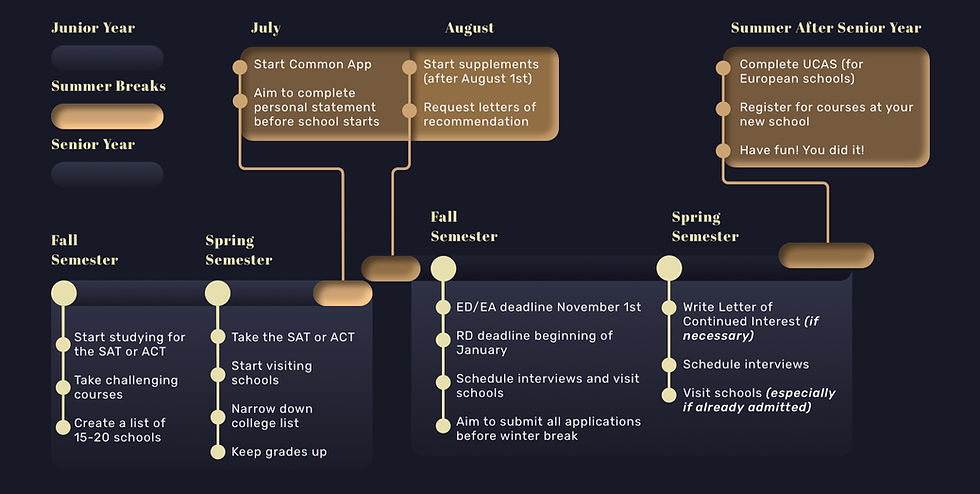
As usual, the students who made meaningful progress during the summer were much happier throughout the process.
Students who finished or substantially drafted their personal statements, activities lists, and early supplemental essays before senior year began had more breathing room. Their applications were not necessarily easy, but they had time to revise, think, and improve without every task feeling urgent. When asked about their experience with the process this year, several of our students mentioned that starting during the summer made the process feel “much lower stress, if any stress at all.” We’ll take it!
We also worked with several families who came to us very late in the process — even in November and December — and some of those students had extraordinary outcomes, including admission to Harvard, Columbia, UPenn, and other Ivies. They really busted it out there at the end!
But the students who started earlier definitely had a better experience. Their families had a better experience. Their essays had more time to develop, and there was less pressure to suddenly make it “perfect” with just a few weeks to go.
Speaking of which: we also noticed that students who submitted applications as soon as they were polished and ready often felt major relief. They were not dragging finished applications around for weeks, second-guessing themselves, or waiting until the deadline crush.
In several cases, students received acceptances earlier than expected. Some schools began releasing decisions on monthly cycles — including August 15 and September 15 — even when that timing was not especially obvious from the application materials. For students who had strong applications ready early, this meant they could begin senior year already knowing they had college options.
College Admissions Officers Want Students Who Feel Human
One of the strongest messages we heard this year — from campus visits, conversations with admissions officers, and industry events — was simple:
Admissions officers want students to feel human.
They do not want essays that sound like polished résumés. They do not want students trying to prove, in every sentence, that they are impressive. They want writing that feels alive. As we like to say, they want that essay to “jump off the desk and do a tap dance.”
They want to understand what a student notices, what they care about, how they think, and what kind of person they might become on campus. Ivy League admissions officers told us that they want to see if a student has developed a “mission” or not, and if they haven’t yet, that’s ok, as long as the student can speak passionately and deeply about their topic of choice.
We heard this directly from admissions officers at schools including Claremont McKenna and Yale, and we saw it reflected in our own students’ outcomes. The essays that worked best were those that felt meaningful, specific, reflective, and genuinely written by a real teenager with a real inner life.
Interviews and Glimpse Videos Mattered
Colleges have different policies about interviews. Some say they matter a lot, while others are clear that they don’t matter at all. But this year we found that traditional interviews, campus interactions, and recorded video responses gave students another chance to become more than a transcript, activities list, and set of essays.
One newer piece of the process that mattered this year was the Glimpse recorded interview. For families unfamiliar with it, Glimpse is a platform some colleges use to collect short video responses from applicants. A prompt appears on screen, the student gets a brief countdown, and then they have about two minutes to answer. Many schools ask students to respond to two prompts. It’s a lot of pressure, and we spent a few hours with each student to prepare them.
Importantly (and somewhat unexpectedly), the questions we saw this year were often not “Why our school?” questions. They were more personal and reflective:
Tell us about an extracurricular you love.
What is a book you have loved reading?
Tell us about a time you navigated conflict with someone else.
What is something that helps us understand how you think?
In other words, Glimpse was not just another box to check. It was an opportunity for students to come across as real people. Students who had actually thought about their experiences — not just listed them — were much better prepared for these moments. They could talk about what they loved, what challenged them, what they learned, and why their interests mattered. We were very grateful that our students took preparing for these interviews seriously!
This is also where admissions officers can often tell the difference between a student who truly loves what they do and a student who has simply stacked activities because someone told them those activities would “look good.” When a student can talk naturally and specifically about their interests, that authenticity comes through quickly.
QuestBridge and Specialized Pathways Created Major Opportunities
We were also thrilled to support a student through the QuestBridge process this year.
QuestBridge is one of the most meaningful and competitive pathways for high-achieving students from lower-income backgrounds, and it can open extraordinary doors. For the right student, it can be a life-changing opportunity.
This is another reason why we emphasize strategy as soon as we start working with a new student. The strongest application process is not just about applying to a long list of schools: it is about understanding which pathways, programs, scholarships, timelines, and opportunities actually fit the student.
For some students, that means Early Decision. For others, it means merit-heavy schools. For others, it means honors colleges, direct-admit programs, arts supplements, athletics, international options, QuestBridge, or other specialized routes. This is part of what we do first with families when we’re starting the process.
The Best Parent Role: Protect the Process Without Taking Over
One of the clearest patterns we saw this year had nothing to do with a particular college, essay topic, or test score. It had to do with the family system around the application process.
The smoothest family-coach-student relationships were usually the ones where parents did not hover over the writing process or try to rewrite the student’s essays. Instead, they helped protect time for the student to do the work and then allowed them to do it.
Some families created a dedicated weekly application block at home. During that time, the student knew: this is when I work on essays, revise supplements, update my activity list, or complete application tasks. The parent’s role was not to sit beside them and manage every sentence. It was to make sure the time existed, that it was treated as important, and that the student had space to focus.
We found that students who had protected weekly work time tended to move faster, feel calmer, and experience less conflict at home. Parents were still involved, but they were involved in a specific, disciplined way: supporting the process without taking over the student’s voice. While this data point may be correlative rather than causative, our students who worked this way all got into their ED school.
Final College Decisions Can Surprise Everyone
Every year, we see some version of this: a student begins the process with one dream school in mind, and by April, their priorities have shifted.
Sometimes that happens because of money. Students notice (and care!) when a school offers them a generous merit package. Even when parents are thinking about the bigger financial picture, students themselves often feel the emotional impact of being valued. A strong scholarship offer can make a student feel wanted.
Sometimes it happens because of communication. If a school’s admissions process feels confusing, delayed, impersonal, or frustrating, students remember that.
It can also happen because a smaller or less initially “obvious” school makes the student feel genuinely seen. A thoughtful admitted student event, a warm note (we saw this make a big difference to students this year), a strong department conversation, a generous scholarship, or a clear sense of community can change everything.
That is why we encourage families not to emotionally commit too early, but to wait until all the information is in: acceptances, scholarships, financial aid, honors programs, campus visits, admitted student events, and the student’s own gut response. This can be SO hard for students, but we think it’s vital because it allows a full and true comparison among offers.
The final decision is often an alchemy of opportunity, affordability, fit, excitement, and how the school treated the student throughout the process, none of which is fully felt until after the decisions come back. The best outcome is not always the most famous name on the list. It is the school where the student has the strongest combination of opportunity, fit, affordability, excitement, and momentum.
What Rising Seniors Should Do Now
If your student is a rising senior, the best thing they can do now is start.
Start the personal statement. Build the school list. Decide whether testing can still strengthen the application. Create a weekly writing schedule. Think carefully about whether summer work, scholarships, interviews, demonstrated interest, or early applications should be part of the strategy. Please, we beg you, do not wait until September to find out how much work this process really requires.
If your student is a junior or younger, this is also the right time to think strategically. Course selection, testing plans, summer opportunities, extracurricular depth, and academic positioning all become much easier when families start before everything feels urgent.
At Kingfisher Prep, we help students build thoughtful school lists, prepare strategically for the SAT or ACT, develop essays that feel personal and compelling, and manage the application process from start to finish. Most importantly, we help students move through the process with structure, confidence, and a clear sense of who they are. And every year, we get to celebrate our students’ incredible success and wish them well as they venture into their next chapter.
Congratulations again to all of our 2025–2026 students. We are so proud of you.
If your family wants expert guidance through this process, we would be happy to help.



Comments